

(PL)O Canada
Everything you learn about Canada playing poker here, and also, a goodbye to the city I love

I haven’t written, played poker, or read very much at all lately. Instead, I spent the last few months trying desperately to extend my Canadian visa (and by extension, losing my mind), accepting that it was a losing battle (this felt oddly comforting), and preparing my move back to the United States. Over the course of a few months, life as I’ve known it for seven years has been careening towards its end, and all I could do was try to steer it somewhere else.
My friends have already heard at length the things I will miss most about Canada, particularly Montreal, my adopted home. I came of age, started my career, met the love of my life, found “my people”, lived here. I love the person I grew into here, and all of the things I discovered about myself. I loved learning to bike here. I loved learning to exist in the winter. I loved finding out how much French people love electronic music. I loved picnicking just for the sake of touching grass after work. I loved the feeling of finally understanding French. I loved learning everything about this country, and moreover, about this idiosyncratic province. Quebec is different from any place I’ve lived before, and it’s different from everywhere else in Canada.
It feels fitting for this Substack, then, to spend some time talking about what playing poker somewhere can teach you about that place. An homage to the country, province, and city that introduced me to the game, if you will.
So, a few things from the tables here that reflect the greater culture of Quebec (and Canada):
Table language politics: Quebec is one of the only places in North America that allows a second language at the poker table. French and English are accepted here: French is the only official language in Quebec, so the English allowance is done out of courtesy to out-of-towners and anglophones. It also means that action takes twice as long to say, as it is announced in both languages— “four players, quatre joueurs”, “ninety-five, quatre-vingt-quinze”, “all in, tapis”— and that it isn’t unusual to have conversations going on in both languages at the same table.
My favorite anti-slow-roll of all time: “J'ai un sept” at showdown from the nice old man I’m playing with. I say his set is definitely good, and he shows a pair of sevens. (‘I have a seven’ and ‘I have a set’ sound exactly the same in French).
It’s also funny to see players call the floor over unclear action in French. For example, most commonly someone can say “j’appelle” (literally ‘I’m calling’), which is considered to be binding, but “je suis” (contextually, either “I am”, or “I follow”) wouldn’t be considered binding despite being colloquially accepted due to the ambiguity of the phrase— this is a ruling I saw, but I can’t imagine that every floor manager would rule the same.
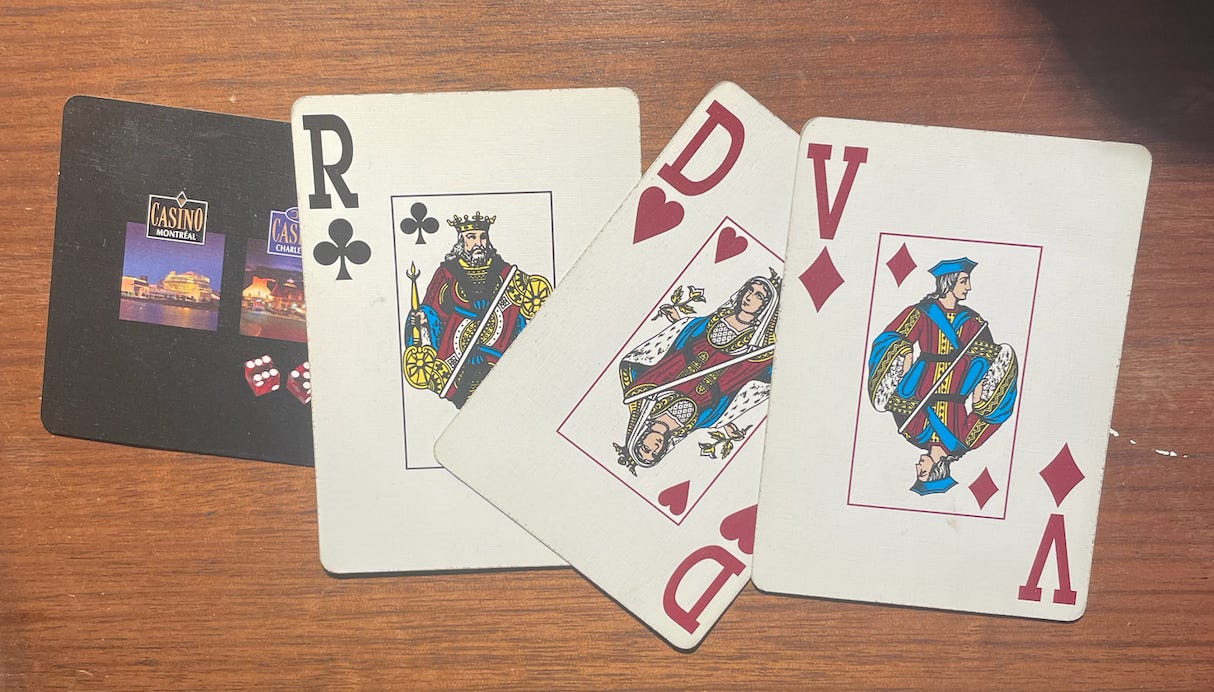
Roi, dame, valet: The Casino de Montréal uses French-language decks for its table games. This builds off the above point: French is the official language of Quebec. The Casino de Montréal, as a government-run entity, procures these decks as a result, but in privately-owned casinos (and every private game in the province, I imagine), the king/queen/jack live on. I need to ask my French friends if they actually use these in France, but I have a feeling that Loto-Québec owns 95% of the world’s French-language decks, because I’ve never seen one for sale.
A lot of people know this point, but far fewer know that you can get a business-card sized reference guide at the poker room desk at CdM that offers translations of all of the cards into English. Essential ephemera for any casual keeper of silly trinkets.
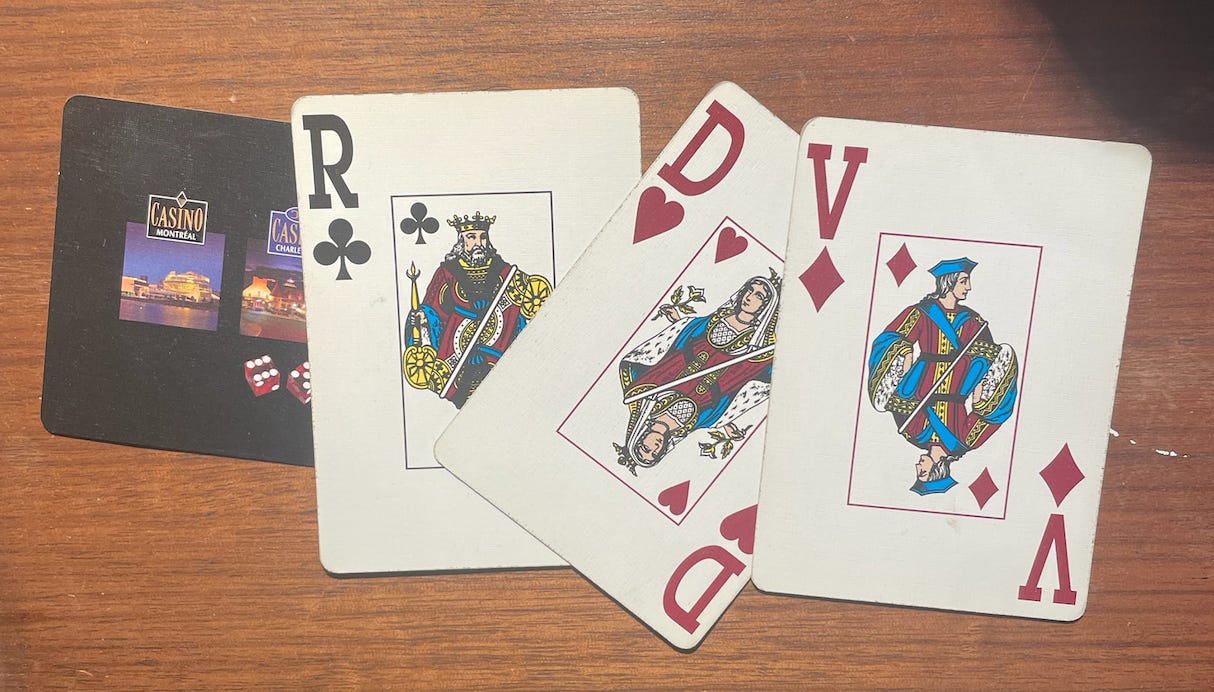
My own vintage deck from the Société des casinos du Québec, the organization that oversees the four casinos in the province PLO-5: I am not a PLO player, but I’ve never played anywhere in the United States that spread PLO-5. At my local card room, PLO-5 is the only PLO variant that’s offered (with a few exceptions for mixed games, and tournament weeks). It seems like this is a variant offered on occasion at some rooms in the US, but it’s the meta here. I can’t find any reason to explain why except that maybe in my local room, where a lot of traffic is driven by record-high Bad Beat Jackpots, that 5th card gives you one extra chance to bink it.
Construction Holiday: My local card room does a small series during a specific period in the Montreal summer called the Construction Power Weeks. In the province of Quebec, this is known as the “construction holiday”, a two-week period where most of the construction industry (and by extension, their employees) closes for vacation. One of the things I love about Quebec is there is a respect for work-life balance and workers more broadly, this being one such example (and it doesn’t hurt that it drives action to the local rooms).
The one complaint I must make: this is in a province where, for most of the year, construction is stalled due to below freezing weather (so you can look at the work in progress until it thaws), and for the few months left in the year, new construction projects pop up faster than anyone can finish them (explaining why they’re all left into winter). This past construction holiday was awesome, because although my entire apartment was enveloped in scaffolding (including my sidewalk), I at least got a pause from waking up to the sound of drilling for two weeks.
Construction, more generally: I don’t drive, and even though my partner has a car, most of our movement is done on foot, by bike, or by public transport. That also means that until I started regularly going in the car to play poker, I didn’t quite understand what Montrealers meant when they say the roads are always closed. That the city is always under construction, I am well aware of (I have eyes), but until you are in the car home from the poker room at an ungodly hour, and they close one of the two bridges back onto the island of Montreal for the weekly construction work, you don’t feel how badly it affects commuting. The only thing you can think in the car is who is working at 4AM, and how many more years is this project going to go on for? It nearly gives me sympathy for all the anti-bike-lane meme-ers, but not enough to give up my Bixi membership.
Taxes: Compared to its southern neighbor, Canada has a really high personal tax rate, Quebec even more so, having the highest provincial income tax rate in the country. The province even levies a 15% sales tax on everything you buy. Unlike its southern neighbor, however, gambling winnings are tax-free in Canada.
This does not apply for those visiting from abroad in countries which do tax gambling winnings as income; as an American, were I to bink something, I’d still owe Uncle Sam a cut, despite not living in the U.S. since I was 17.
Really young kids run this town: Everyone knows the image of a sharp young man in a poker room. Maybe he has some AirPods in, a hoodie, a fanny pack. He’s either a shark or the biggest degen you’ve ever seen. But in Quebec, the crowd runs even younger, where the minimum age to drink or gamble is only 18. In most other provinces, that age is 19. There’s a fair number of 18-year-old Ontarians who drive to the Casino du Lac-Leamy, located right on the border between Quebec and Ottawa in Gatineau (to be clear, here “the border” means a 10 minute drive from downtown Ottawa), specifically to be able to have a nice degen night out.
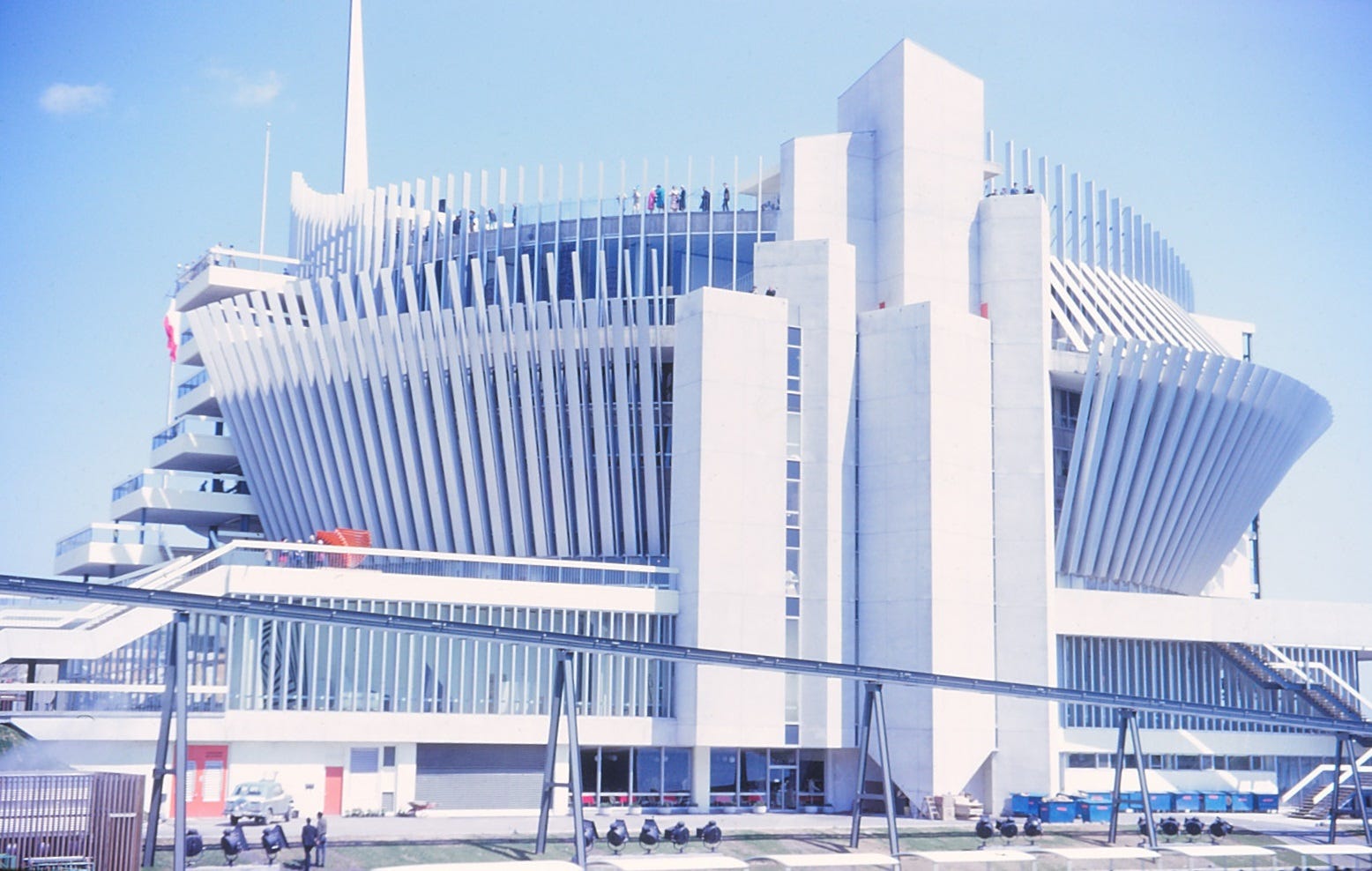
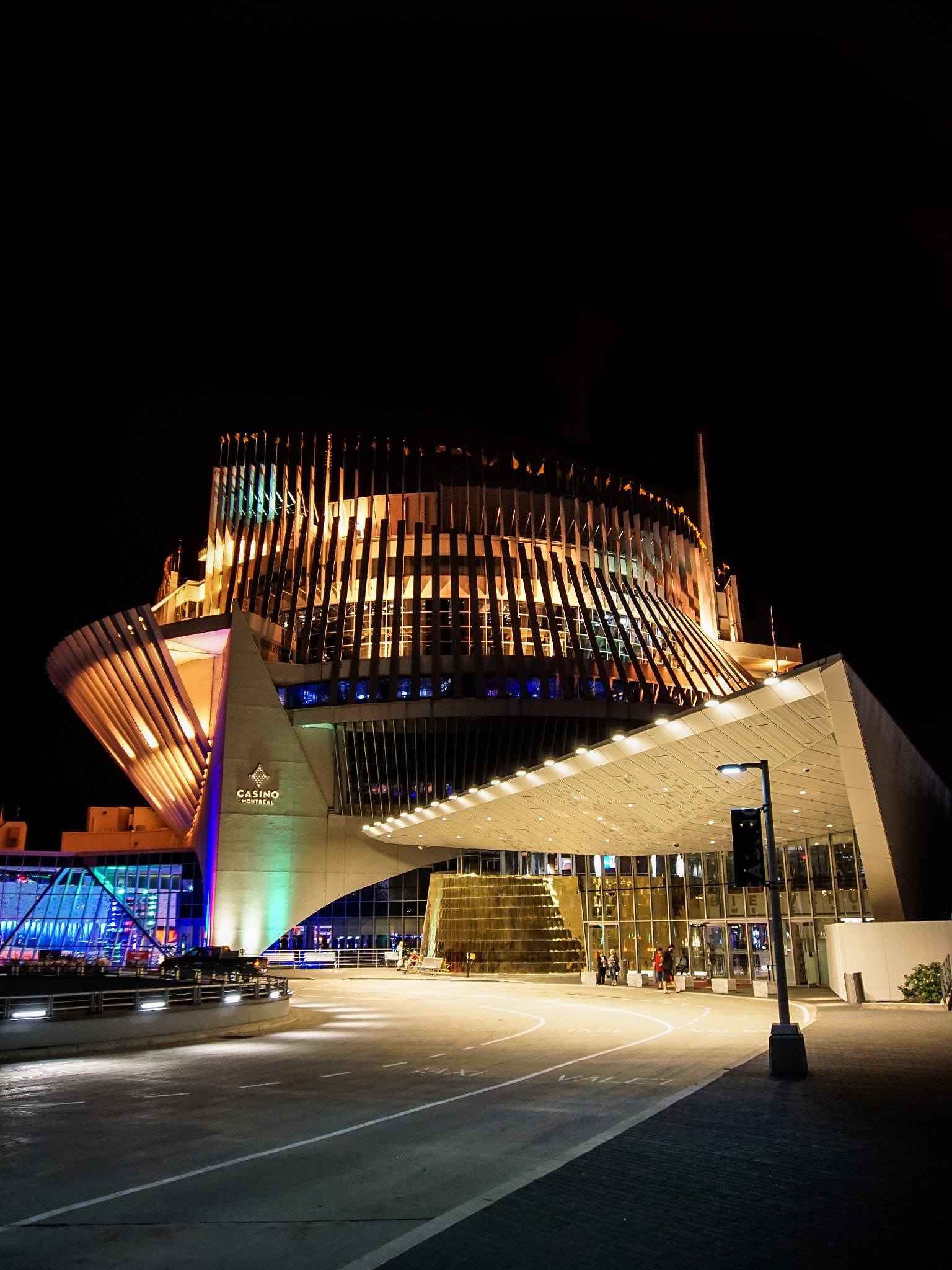
Expo67 changed the city: A ton of infrastructure projects were launched for the 1967 World Expo hosted in Montreal. That includes major metro lines, the islands that now host the Osheaga music festival and Formula 1, and, albeit not intentionally, the Casino de Montreal. Despite having a really terrible poker room, CdM is a beautiful property, in large part because in a past life, the building was actually the French pavilion at the World Expo. Unlike most other casinos, it has windows, and contributes to the landscape of the island it’s on, rather than being an eyesore intentionally designed to get as many eyes on it as possible. It fits right in alongside the Biosphère (formerly, the American pavilion at Expo67) and Habitat67 (the beautifully brutalist housing complex) as a testament to the sort of creative vision that continues to make the city great.
I am sure that there are more things to mention: things I have learned from players, the fact that Loto-Québec dealers are unionized, et cetera, et cetera, but these are the things that just come to mind. I am so incredibly lucky to have been able to come to Canada. I am even more lucky to have settled in Montreal, a city which I believe punches far above its weight in quality of life, vivacity, and food/drink/urbanism/love-liness. It’s nice to reflect on the little things that make the city what it is.
I have spent weeks talking through everything I love here, the things I learned here, the things that I’ll miss. But this is my poker Substack, so I’ll thank this city for one last thing: being the place I started playing this game. And besides, it’s more an à la prochaine than an adieu.
Have you been to playground? I heard they have a huge bad beat jackpot
Really fantastic write-up. As someone who left the US in 2019, my deepest condolences for your inevitable trip home.